
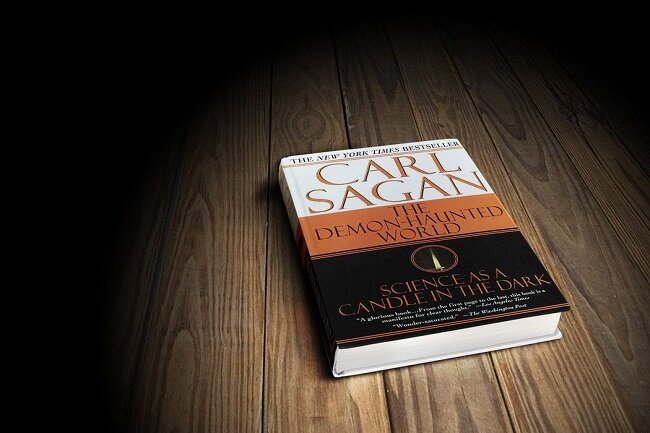
– Carl Sagan’s Fine Art of Baloney Detection, The Demon-Haunted World: Science as a Candle in the Dark
On to the seventh tool. Too date you have got the facts (1 of 10), you had a substantive debate (2 of 10), you’ve covered arguments from authority (3 of 10), you have several hypotheses (4 of 10), you aren’t overly attached to any one hypothesis, especially if it’s your own thought (5 of 10) and (6 of 10) numerical quantities. Here is number 7:
If there’s a chain of argument, every link in the chain must work (including the premise) — not just most of them.

All the points in your argument need to stand on their own merits, and link to the next point.
A chain is only as strong as its weakest link.
If one point of your argument is weak the whole argument may fall apart. You should carefully analyze the argument and strengthen (or better still, replace) the weakest link.

Credit: https://www.pinterest.com/pin/436215913897889023/
A chain argument is a series of connected premises that build on each other to reach a conclusion. Here is an example at the basic structure of a chain argument. If it is raining, I’ll get wet. If I get wet, it’ll be cold. It’s raining, so I’ll get cold.
It is important to realise that chain arguments need to be carefully considred because they can be prone to exaggeration and fallacy. For example, I remember Carl Sagan using the following example to illustrate the risks of fallacy, he said something along the lines of:
“My eyes are blue and my nose itches. Your eyes are blue therefore your nose must itch, too.”
How strong are your links?!
PS: I love coffee. BuyMeACoffee, leave a message with a date and time and we can share it, remotely, at the same time, and think about the Cosmos.
In the meantime, take care of yourself and if you can, someone else, too, because as Adam Smith said, “we naturally desire not only to be loved but to be lovely”.
Contact Stargazing Guy for any copyright-related requests or queries @ stargazer1@stargazingguy.co.uk

 Stargazing Guy
Leave a comment