
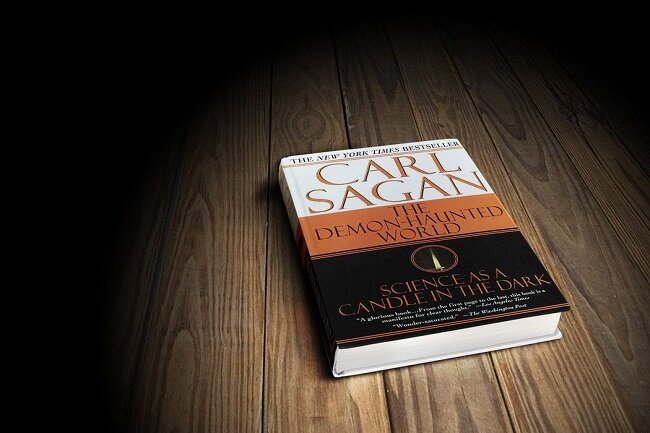
– Carl Sagan’s Fine Art of Baloney Detection, The Demon-Haunted World: Science as a Candle in the Dark
It’s time for the sixth tool. So far you have got the facts (1 of 10), you had a substantive debate (2 of 10), you’ve covered arguments from authority (3 of 10), you have several hypotheses (4 of 10) and you aren’t overly attached to any one hypothesis, especially if it’s your own thought (5 of 10). Here is number 6:
Quantify.
If whatever it is you’re explaining has some measure, some numerical quantity attached to it, you’ll be much better able to discriminate among competing hypotheses. What is vague and qualitative is open to many explanations. Of course, there are truths to be sought in the many qualitative issues we are obliged to confront, but finding them is more challenging.
That ability to discriminate among competing hypotheses, especially if one is your favourite, is essential. Aside from quantification, are there any other techniques that can be used to guide us? Yes.
Whether in scientific research or in everyday life, we often need to choose among alternative explanations or theories. Here are six criteria that can be used to evaluate them and help us decide which to accept.
- Consistency with Observations
- Predictive Power
- Mechanism
- Fruitfulness
- Simplicity
- Coherence
These six criteria are expanded on in this course outline PHIL102: Introduction to Critical Thinking and Logic (2018.A.01).
The goal is to find the hypothesis that best fits the evidence.
PS: I love coffee. BuyMeACoffee, leave a message with a date and time and we can share it, remotely, at the same time, and think about the Cosmos.
In the meantime, take care of yourself and if you can, someone else, too, because as Adam Smith said, “we naturally desire not only to be loved but to be lovely”.
Contact Stargazing Guy for any copyright-related requests or queries @ stargazer1@stargazingguy.co.uk

 Stargazing Guy
Leave a reply to Carl Sagan’s “baloney detection kit” – blog 8 of 10 – Stargazing Guy Cancel reply