
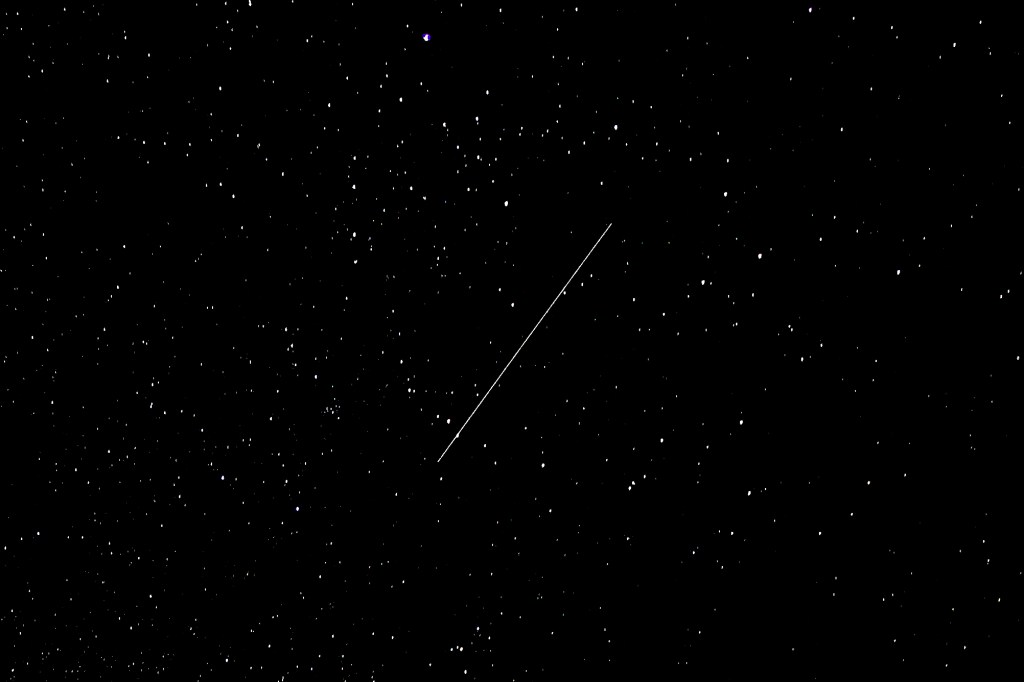
Caption: Perseid Meteor from UK 12-13 Aug 2021 (credit in ALT)
I was asked this question during a recent talk on stargazing.
Easy question to answer, was my first thought. I started with confirming that they were indeed different phenomena and went on to discuss where comets came from, their usual long orbits (unless they get captured by Jupiter’s gravity) and the fact that they are essentially dirty snowballs.
I then moved on to shooting stars – talking about fireballs, meteors, meteorites, meteoroids, meteor showers and asteroids – and it was here that my answer got a bit jumbled and not as clear as I would have preferred.
So, here is a more structured answer, related to the question:
“Are comets and shooting stars the same?”
The question I am going to answer is what is the difference between asteroids, meteoroids, meteors, meteorites, shooting stars and comets?
The best way to distinguish them is based on three factors – composition, size, and location.
Asteroids are composed of rock and metal, and range in size from 1m to around 1,000km. Most are in the Asteroid Belt, which is about midway between Mars and Jupiter. The Asteroid Belt is mainly empty space, despite having millions of asteroids in it.
Comets are made up of ice, rocks, and dust (often described as a ‘dirty snowball’). They tend to have a rocky nucleus covered by clumps of rock, dust and ice. Comets vary in size from a few hundred metres, up to tens of kilometres. The majority are in the Kuiper Belt (beyond Neptune) or the Oort Cloud (outside the Solar System). They have highly elliptical orbits, spend most of their time outside the Solar System, orbiting in the Oort Cloud and can hundreds or thousands of years to orbit the Sun.
As comets get closed to the Sun, they develop two tails, one made of dust, and one made of gas. The comet’s gas tail always points away from the Sun, because of electrically charged solar wind particles.
Halley’s Comet is currently (May 2023) around its furthest point from the Sun (c5,252 million km) and will be visible from the Earth in 2061. It has a diameter of 6.84 miles and orbits the Sun once every 75 years.
Meteoroids are found in space. Once they enter the Earth’s atmosphere, they are called meteors (and are also called Shooting Stars). When they land on Earth, they’re meteorites.
Meteoroids, meteors, and meteorites can be anything from 1m diameter, down to the size of a grain of sand.
There are an estimated 30 million small asteroids in the Solar System, and a handful of large ones. Which can include larger objects up to the size of Pluto, which was recently downgraded to a dwarf planet. There has to be a dividing line somewhere and, unfortunately, Pluto fell below that line.
Asteroids are rarely anything close to spherical, and usually have irregular shapes.
Planets and dwarf planets are spherical because they have sufficient mass for their gravitational force to make their shape symmetrical.
There are also a significant number of asteroids close to the orbital path of Jupiter.
As well as comets, there are some asteroids in the Kuiper Belt (beyond Neptune), but they tend to be more icy than rocky.
Meteoroids, meteors and meteorites are all the same thing, in different locations.
They tend to be small, rocky and metallic.
As a meteoroid enters the Earth’s atmosphere, it heats up due to pressure from air molecules, and becomes a meteor.
If an asteroid or comet enters the Earth’s atmosphere, that would also be known as a meteor, but is a relatively rare occurrence.
Most meteors burn up before they reach the Earth’s surface. Those that do survive the journey are called meteorites.
There are specific meteor showers that happen at the same time every year because the Earth is passing through an area of space which contains debris from asteroids and/or comets. Meteor showers appear to radiate from specific constellations and their duration and visibility can vary depending on the weather, position and phase of the Moon, levels of darkness (due to nightfall and light pollution), etc.
Here is a brief overview of some of the main meteor showers:
Quadrantids – peaks around 3 January. Radiant: Boötes (originally Quadrans Muralis). Peak meteor count can be up to 80 meteors per hour but only for a few hours on the peak date. A relatively slow 26 miles/second and its origin is Asteroid 2003 EH1.
Lyrids – peaks around 22 April. Radiant: Lyra. Peak meteor count can be up to 18 meteors per hour. Around 29 miles/second and its origin is Comet C/1861 G1 Thatcher.
Eta Aquarids – peaks around 5 May. Radiant: Aquarius. Peak meteor count can be up to 30 meteors per hour. Around 44 miles/second and its origin is Comet 1P Halley.
Southern Delta Aquarids – peaks around 30 July. Radiant: Aquarius. Peak meteor count can be up to 20 meteors per hour. Around 25 miles/second and its origin is (probably) Comet 96P Machholz.
Perseids – peaks around 12/13 August. Radiant: Perseus. Peak meteor count can be up to 100 meteors per hour. Around 37 miles/second and its origin is Comet 109P/Swift-Tuttle.
Orionids – peaks around 21 October. Radiant: Orion (close to Betelgeuse). Peak meteor count can be up to 15 meteors per hour. Around 41 miles/second and its origin is Comet 1P/Halley.
Leonids – peaks around 18 November. Radiant: Leo. Peak meteor count can be up to 15 meteors per hour. Around 44 miles/second and its origin is Comet 55P/Tempel-Tuttle.
Geminids – peaks around 13/14 December. Radiant: Gemini. Peak meteor count can be up to 120 meteors per hour. Around 22 miles/second and its origin is Asteroid 3200 Phaethon.
The higher the speed the quicker the meteors disappear!
To finish, and to go back to the original question, a comet is a large, dirty snowball that orbits the Sun and shooting stars (aren’t stars) they are small fragments of rock and dust that burn up in the Earth’s atmosphere.
PS: I love coffee. BuyMeACoffee, leave a message with a date and time and we can share it, remotely, at the same time, and think about the Cosmos.
In the meantime, take care of yourself and if you can, someone else, too, because as Adam Smith said, “we naturally desire not only to be loved but to be lovely”.
Contact Stargazing Guy for any copyright-related requests or queries @ stargazer1@stargazingguy.co.uk


Leave a comment