
– Frank White, Author, Space Philosopher, Consultant
William Shatner cried upon returning from space. The “overview effect” explains why.
The “overview effect”, experienced by astronauts when they view the Earth from outer space, irrevocably changes your perspective as a human.
Coined by Frank White in 1987, the overview effect describes what the spaceflight experience, for lack of a better term, awakens in those who venture beyond the bonds of Earth. As White himself writes:
“There are no borders or boundaries on our planet except those that we create in our minds or through human behaviors. All the ideas and concepts that divide us when we are on the surface begin to fade from orbit and the moon. The result is a shift in worldview, and in identity.”
The Overview Effect is an experience that has been reported by astronauts and cosmonauts who have traveled into Low Earth Orbit or to the moon – and a handful of test pilots.
There are many aspects to the Overview Effect, but at its most basic level, it represents a cognitive shift in which one sees the Earth as a planet moving through a star-filled universe. For most, there is also a realization that there are no borders or boundaries on this planet, except those created by human beings.
You don’t need to go out in space to receive the Overview Effect. A lesser version of the effect is achieved through photographs and video, and even these minor effects have had profound implications on humanity, and our understanding of ourselves. In 1950, astronomer Sir Fred Hoyle made a prediction on BBC radio, “Once a photograph of the Earth, taken from outside is available – once the sheer isolation of the Earth becomes known – a new idea as powerful as any in history will be let loose.” That prediction came true, embodied in the three most widely known example.
The Blue Marble – 7 December 1972

Description/source: “The Blue Marble” is a famous photograph of the Earth taken on December 7, 1972, by the crew of the Apollo 17 spacecraft en route to the Moon at a distance of about 29,000 kilometres (18,000 mi). It shows Africa, Antarctica, and the Arabian Peninsula. Date 7 December 1972
https://web.archive.org/web/20160112123725/http://grin.hq.nasa.gov/ABSTRACTS/GPN-2000-001138.html
The Earthrise – 22 December 1968
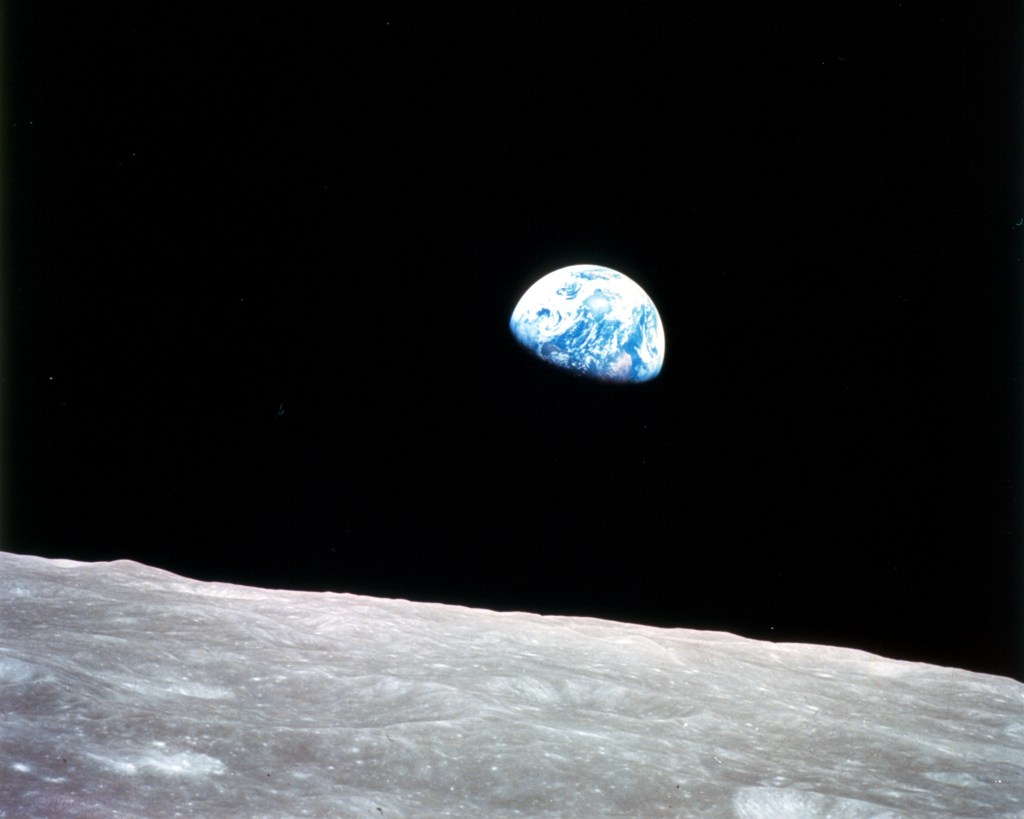
Description/source: This view of the rising Earth greeted the Apollo 8 astronauts as they came from behind the Moon after the fourth nearside orbit. Earth is about five degrees above the horizon in the photo. The unnamed surface features in the foreground are near the eastern limb of the Moon as viewed from Earth. The lunar horizon is approximately 780 kilometers from the spacecraft. Width of the photographed area at the horizon is about 175 kilometers. On the Earth 240,000 miles away, the sunset terminator bisects Africa. Date 24 December 1968
The photo ignited the imagination of humanity, and is considered one of the most significant photos ever taken. It happened spontaneously, when the astronauts were suddenly in awe of the view. Here is the conversation which took place between the astronauts:
Borman: “Oh my God! Look at that picture over there! Here’s the Earth coming up. Wow, is that pretty.”
Anders: “Hey, don’t take that, it’s not scheduled.”
Borman: (laughing) “You got a color film, Jim?”
Anders: “Hand me that roll of color quick, will you…”
Lovell: “Oh man, that’s great!”
Three days later, the poet Archibald MacLeish wrote Riders on the Earth, in which he described the response to seeing Earthrise, “For the first time in all of time, men have seen the Earth. Seen it not as continents or oceans from the little distance of a hundred miles or two or three, but seen it from the depths of space; seen it whole and round and beautiful and small. To see the Earth as it truly is, small and blue and beautiful in that eternal silence where it floats, is to see ourselves as riders on the Earth together, brothers on that bright loveliness in the eternal cold – brothers who know that they are truly brothers.” Apollo 8 astronaut Jim Lovell stated at the time, “The vast loneliness up here at the moon is awe inspiring, and it makes you realize what you have back there on Earth. The Earth from here is a grand oasis in the big vastness of space.”
The Pale Blue Dot – 14 February 1990
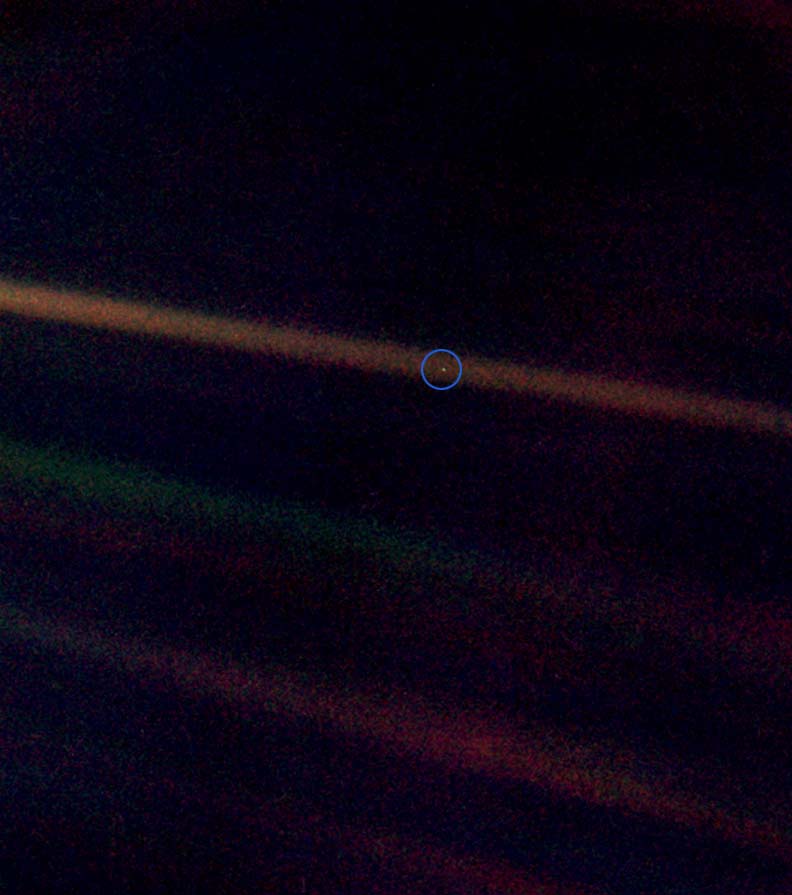
Description/source: This is the “Pale Blue Dot” photograph of the Earth taken by the Voyager 1 spacecraft on February 14, 1990. The Earth is the relatively bright speck of light about halfway across the uppermost sunbeam.
The original version of this image can be obtained from NASA.The original caption reads as follows:
This narrow-angle color image of the Earth, dubbed ‘Pale Blue Dot’, is a part of the first ever ‘portrait’ of the solar system taken by Voyager 1. The spacecraft acquired a total of 60 frames for a mosaic of the solar system from a distance of more than 4 billion miles from Earth and about 32 degrees above the ecliptic. From Voyager’s great distance Earth is a mere point of light, less than the size of a picture element even in the narrow-angle camera. Earth was a crescent only 0.12 pixel in size. Coincidentally, Earth lies right in the center of one of the scattered light rays resulting from taking the image so close to the sun. This blown-up image of the Earth was taken through three color filters — violet, blue and green — and recombined to produce the color image. The background features in the image are artifacts resulting from the magnification. https://commons.wikimedia.org/wiki/File:PaleBlueDot.jpg
PS: I love coffee. BuyMeACoffee, leave a message with a date and time and we can share it, remotely, at the same time, and think about the Cosmos.
In the meantime, take care of yourself and if you can, someone else, too, because as Adam Smith said, “we naturally desire not only to be loved but to be lovely”.
Contact Stargazing Guy for any copyright-related requests or queries @ stargazer1@stargazingguy.co.uk

 Stargazing Guy

Leave a reply to Do you share a birthday with an astronaut? 30 October – 6 November (no.10) – Stargazing Guy Cancel reply