
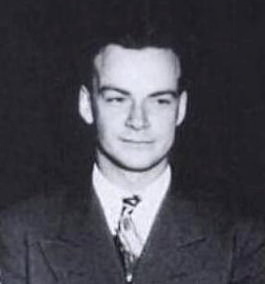
– Richard P. Feynman (11 May 1918 – 15 Feb 1988)
From the Manhattan Project to the Challenger investigation, the physicist and Nobel Laureate Richard Feynman loved to shoot down what he called “lousy ideas.” Today, the world is awash in lousy ideas — so maybe it’s time to get some more Feynman in our lives?
Credit: https://freakonomics.com/podcast/the-curious-mr-feynman/
_________________________________________________________________________________________________________________
From an address “What is Science?”, presented at the fifteenth annual meeting of the National Science Teachers Association, in New York City (1966), published in The Physics Teacher, volume 7, issue 6 (1969), p. 313-320.
A longer quote from the same address is in blog no 26, What is Science?”.
The full quote is:
“When someone says, “Science teaches such and such,” he is using the word incorrectly. Science doesn’t teach anything; experience teaches it. If they say to you, “Science has shown such and such,” you might ask, “How does science show it? How did the scientists find out? How? What? Where?”
It should not be “science has shown” but “this experiment, this effect, has shown.” And you have as much right as anyone else, upon hearing about the experiments–but be patient and listen to all the evidence–to judge whether a sensible conclusion has been arrived at.”
This is, I think, along with “Science is the belief in the ignorance of experts”, something that should be at the heart and forefront of every scientist’s mind, especially when they are discussing their area of expertise to non-scientists, such as politicians, civil servants, the press and, most importantly, you and me.
Poor science leads to pseudoscience, conspiracies, and undermines our technological society and as Feynman puts it near the end of his address, “… there is a considerable amount of intellectual tyranny in the name of science.
He ends the address with these words:
“It is necessary to teach both to accept and to reject the past with a kind of balance that takes considerable skill. Science alone of all the subjects contains within itself the lesson of the danger of belief in the infallibility of the greatest teachers of the preceding generation.”
“… a good scientist should always maintain a healthy amount of scepticism. Science is, by its nature, provisional …”
Credit: Brian Keating, professor of physics at the University of California, San Diego and author of Losing the Nobel Prize, for Prager University.
More from Feynman, next time.
______________________________________________________________________________________________
PS: I love coffee. BuyMeACoffee, leave a message with a date and time and we can share it, remotely, at the same time, and think about the Cosmos.
In the meantime, take care of yourself and if you can, someone else, too, because as Adam Smith said, “we naturally desire not only to be loved but to be lovely”.
Remember, hope lives here.
Opening image source: https://commons.wikimedia.org/wiki/File:Feynman_at_Los_Alamos.jpg
Contact Stargazing Guy for any copyright-related requests or queries @ stargazer1@stargazingguy.co.uk
 Stargazing Guy

Leave a comment