

– Carl Sagan, The Demon-Haunted World: Science as a Candle in the Dark
This is the final blog in this series and is intended to bring everything together with a summary, from Sagan, from some other sources and maybe one or two comments from me.
____________________________________________________________________
Rules for critical thinking (as per Carl Sagan’s Fine Art of Baloney Detection, extracted from The Demon-Haunted World: Science as a Candle in the Dark).
This series of blogs (and the previous series) describe Sagan’s baloney detection kit – his 20 most common pitfalls of common sense and 9 cognitive tools and techniques that can be used to avoid falsehood and deception – here summarised:
9 cognitive tools and techniques –
- The facts
- You had a substantive debate
- You’ve covered arguments from authority
- You have several hypotheses
- You aren’t overly attached to any one hypothesis, especially if it’s your own
- You have the numbers
- Every link in the chain works
- Occam’s Razor has been applied
- Your hypotheses can be falsified
20 most common pitfalls of common sense –
- ad hominem
- argument from authority
- argument from adverse consequences
- appeal to ignorance
- special pleading
- begging the question, also called assuming the answer
- observational selection, also called the enumeration of favourable circumstances
- statistics of small numbers
- misunderstanding of the nature of statistics
- inconsistency
- non sequitur
- post hoc, ergo propter hoc — Latin for “It happened after, so it was caused by”
- meaningless question
- excluded middle, or false dichotomy
- short-term vs. long-term
- slippery slope, related to excluded middle
- confusion of correlation and causation
- straw man
- suppressed evidence, or half-truths
- weasel words
Sagan ends the chapter from his book (The Demon-Haunted World: Science as a Candle in the Dark) with a necessary disclaimer:
Like all tools, the baloney detection kit can be misused, applied out of context, or even employed as a rote alternative to thinking. But applied judiciously, it can make all the difference in the world — not least in evaluating our own arguments before we present them to others.
… and to end on a further note of caution, long before Sagan equipped us with the antidote to the “common pitfalls of common sense”, he told Jonathan Cott (an American author, journalist, and editor) in an interview for Rolling Stone, published on 25 December 1985:
“Common sense works fine for the universe we’re used to, for time scales of decades, for a space between a tenth of a millimetre and a few thousand kilometres, and for speeds much less than the speed of light. Once we leave those domains of human experience, there’s no reason to expect the laws of nature to continue to obey our expectations, since our expectations are dependent on a limited set of experiences.
[…]
We have to be very careful not to impose our hopes and desires on the cosmos, but instead, in the scientific tradition and with the most open mind possible, see what the cosmos is saying to us.”
Despite the balance needed to not be taken in versus rejecting everything, I’ll leave the final word with Sagan and Ann Druyan (from the same Rolling Stone interview):
“There are two extremes to worry about. One is the extreme in which everything is known and there’s nothing left to do. The other is where everything is so complicated you can never begin to do anything. We are lucky to live in a universe were there are laws of nature and things to discover, but they’re not impossibly difficult, so we can understand them to some extent. But they’re also difficult enough so that we’re nowhere near understanding them all. There are exhilarating discoveries yet to be made. It’s the best possible world.
“The best possible Cosmos!”
That’s all from Sagan, for the moment, as other writers and scientists have their views too.
Melanie Trecek-King is an Associate Professor of Biology at Massasoit Community College, where she teaches a general-education science course designed to equip students with empowering critical thinking, information literacy, and science literacy skills. Her website (https://thinkingispower.com/) is based on a general-education science course designed to teach students critical thinking, information literacy, and science literacy skills.
Her linked articles provide useful and practical skills and ideas on how to avoid the pitfalls and improve your ability to do your own research – which as she states:
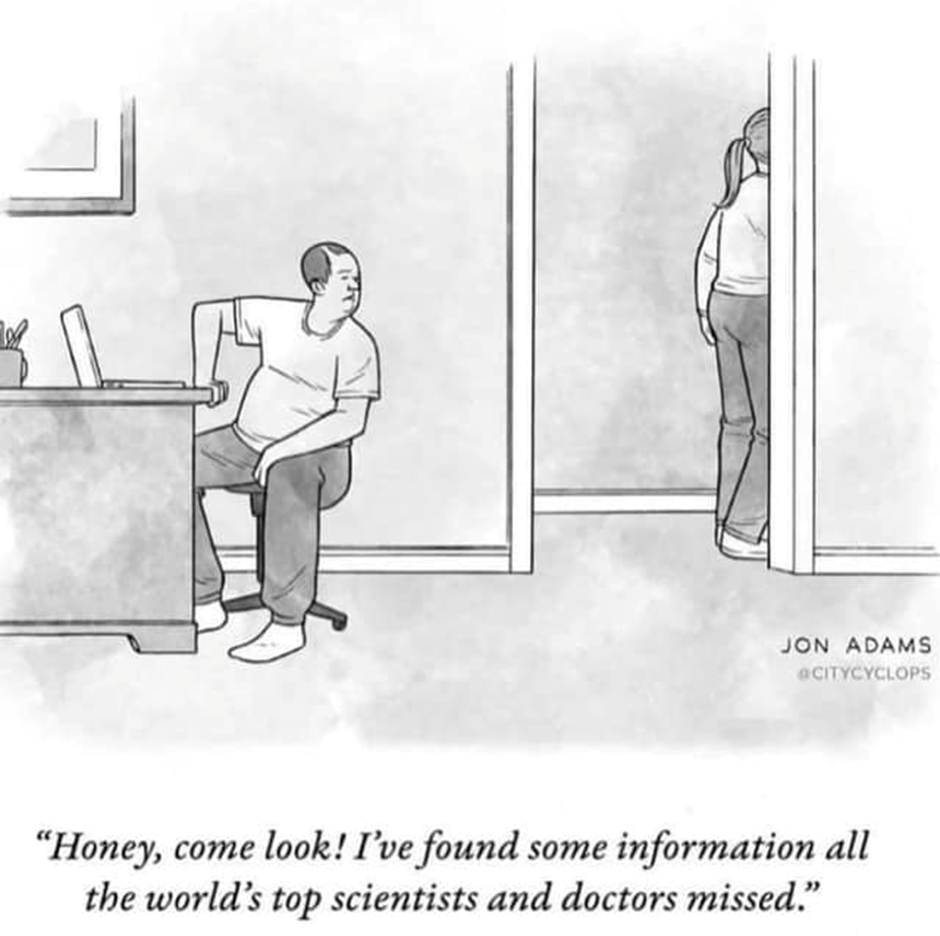
“The phrase “do your own research” seems ubiquitous these days, often by those who don’t accept “mainstream” science (or news), conspiracy theorists, and many who fashion themselves as independent thinkers. On its face it seems legit. What can be wrong with wanting to seek out information and make up your own mind?”
Click below for further details:
- The problem with ‘doing your own research’: http://thinkingispower.com/the-problem-with-doing-your…/
- How to do your own research: https://thinkingispower.com/how-to-do-your-own-research/
A further point that needs to be considered by anyone concerned about facts, the truth, science and how science is used/misused, is the concept of ‘peer review’. Peer review is the process where other experts evaluate someone else’s work before it can be published – and can be considered the bedrock of scientific research and respectability.
Peer review is promoted in the two above articles as a positive force. There are concerns about the peer review process and, in recognition of the need for balance, here is an article, published in the Journal of the Royal Society of Medicine that discusses those concerns, called Peer review: a flawed process at the heart of science and journals.
In it the author states:
“So we have little evidence on the effectiveness of peer review, but we have considerable evidence on its defects. In addition to being poor at detecting gross defects and almost useless for detecting fraud it is slow, expensive, profligate of academic time, highly subjective, something of a lottery, prone to bias, and easily abused.”
His conclusion:
“So peer review is a flawed process, full of easily identified defects with little evidence that it works. Nevertheless, it is likely to remain central to science and journals because there is no obvious alternative, and scientists and editors have a continuing belief in peer review. How odd that science should be rooted in belief.”
Probably something conspiracy theorists should be focussing on in their campaign to dismiss science and experts!
Pascal in De L’Art de Persuader said “people almost invariably arrive at their beliefs not on the basis of proof but on the basis of what they find attractive.”
Gilby E. Sublime Worlds: Early Modern French Literature, Taylor and Francis. 2006. [Google Scholar]
In conclusion, and in my own words, humanity’s history is littered with the consequences of lies and falsehoods and deceit coupled with the lack of learning of mistakes.
Because, the Internet, with its vast resources of information, is still new and learning is slow it can appear that fake news, distrust of experts and misinformation is a huge wave that threatens to engulf and maybe destroy us.
For me, there is hope, hope that self-correcting mechanisms will evolve and turn the wave into a rising tide where facts aren’t contentious, opinions are personal, and the rationality of the scientific method is understood and accepted by everyone and not abused by anyone.
The future of humanity will be wonderful and startling and (from where we are now) unbelievable. We are on the first steps on the ladder that will take us to the stars and spread life throughout the galaxy and beyond; the steps on the ladder that will provide immortality to those that want it; the steps on the ladder to increase our intelligence. It will take the collective goodwill and perseverance and intelligence and love and wisdom and an abundance mindset of all of us to negotiate our present to reach the future.
“Always make your future bigger than your past.”
― Dan Sullivan, The Quotable Dan Sullivan
Listed below is a range of websites and links (in no order) that focus on the positive – news, people, resources, stories, ideas, etc – some are focussed on the near-term (solutions to today’s problems) and some are more future-focussed (how to get there) – all with a similar approach of being focussed on opportunities not obstacles; hope not cynicism; strengths not weaknesses; science not pseudoscience; optimism not pessimism; abundance not scarcity; love not passion: calm not angry; joy not despair; selfless not selfish; an infinite mindset not a finite mindset; boom not doom; common sense not nonsense; curious not furious; with clarity not confusion; and to end this blog on a positive note!
Let me know your favourites and add any of your own in the comments:
https://www.humanprogress.org/
https://www.diamandis.com/blog/scaling-abundance
https://www.brightmirror.co/p/the-existential-accelerationism-manifesto
https://copenhagenconsensus.com/
https://bigpicturescience.org/episodes/building-a-space-colony
… and remember hope lives here.
____________________________________________________________________
PS: I love coffee. BuyMeACoffee, leave a message with a date and time and we can share it, remotely, at the same time, and think about the Cosmos.
In the meantime, take care of yourself and if you can, someone else, too, because as Adam Smith said, “we naturally desire not only to be loved but to be lovely”.
Remember, hope lives here.
Contact Stargazing Guy for any copyright-related requests or queries @ stargazer1@stargazingguy.co.uk
 Stargazing Guy
Leave a comment