
Discussing originality and plagiarism, Matthew Syed uses the release of two very similar movies in 1998, Armageddon and Deep Impact, as an example of how our brains are wired for unoriginality. He finds, in his Radio 4 series Sideways (available as a podcast), that we evolve as a collective brain, absorbing our shared cultural cues and looking for what has worked in the past.
Although both movies share similar storylines, they are vastly different in terms of tone (don’t forget that song by Aerosmith from Armageddon!); but was the making of those movies linked to an astronomical event four years earlier when fragments of the Shoemaker-Levy 9 Comet smashed into Jupiter, also hitting the headlines across the world?
Plugging into the shared cultural cues of disaster movies and ELEs (Extinction Level Events) persuaded me to rediscover the comet that may have kicked-started their development and have look at what happened.
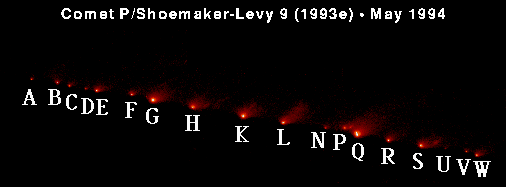
Comet Shoemaker-Levy 9 (formally designated D/1993 F2) was a comet that was discovered on 24 March 1993 by Carolyn and Gene Shoemaker and David Levy at Mt. Palomar.
Before the discovery, it had been torn apart into at least 21 pieces and these fragments collided with Jupiter between 16 and 22 July 1994, providing the first direct observation of an extraterrestrial collision of Solar System objects.
It was also the first comet observed to be orbiting a planet – in this case, Jupiter – rather than the Sun.
The collision provided new information about Jupiter highlighting its possible role in reducing space debris in the inner Solar System.
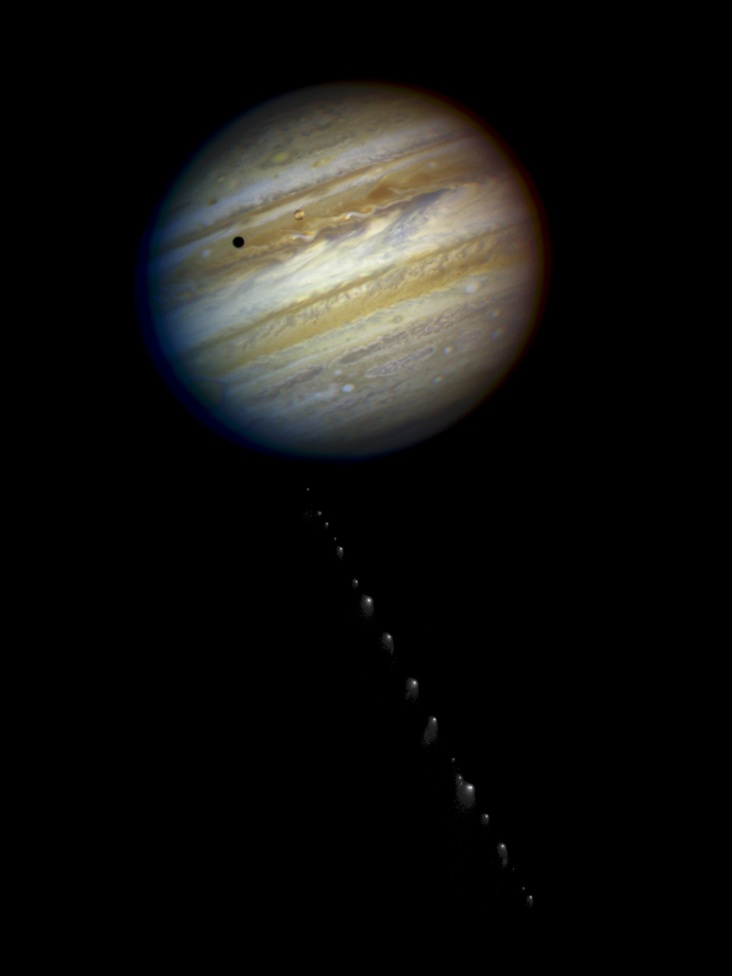
Along with NASA’s Galileo orbiter (then still en route to Jupiter), many Earth-based observatories and orbiting spacecraft including Hubble Space Telescope, Ulysses, and Voyager 2 also studied the impact and its aftermath.
According to NASA, the fragments, at impact, were travelling at a speed of about 37 miles/second (60 km/second) when they smashed into Jupiter with the force of 300 million atomic bombs.
The fragments created huge plumes that were 1,200 to 1,900 miles (2,000 to 3,000 kilometres) high and heated the atmosphere to temperatures as hot as 30,000 to 40,000 degrees Celsius. Shoemaker-Levy 9 left dark, ringed scars that were eventually erased by Jupiter’s winds.
Scientists have calculated that the comet was originally about 0.9 to 1.2 miles (1.5 to 2 kilometres) wide. If a similar-sized object were to hit Earth, it would be devastating. The impact might send dust and debris into the sky, creating a haze that would cool the atmosphere and absorb sunlight, enveloping the entire planet in darkness. If the haze lasted long enough, plant life would die – along with the people and animals that depend on it to survive.
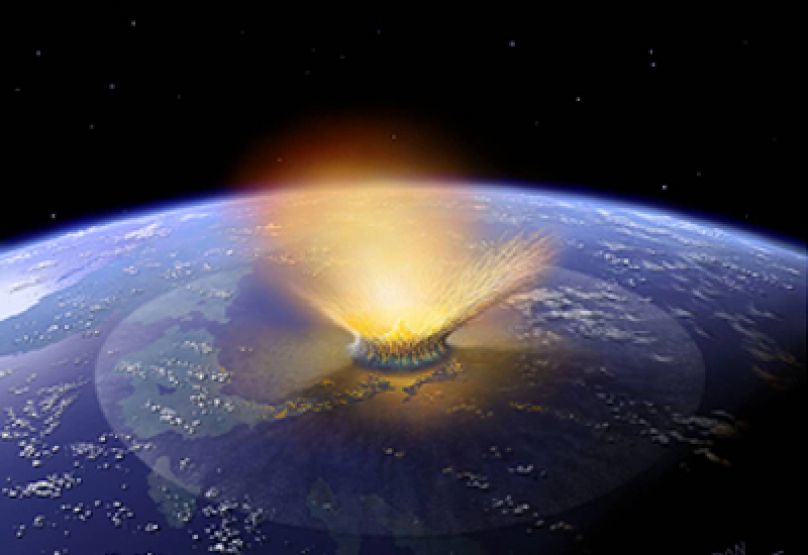
Comet Shoemaker-Levy 9 showed us that large impacts still happen in the Solar System and were a factor in NASA developing programs to address the impact risk to Earth.
From comet science to Jupiter science, to the science of impacts, the legacy of that discovery by Carolyn and Gene Shoemaker and David Levy continues to this day and into the future.
PS: I love coffee. BuyMeACoffee, leave a message with a date and time and we can share it, remotely, at the same time, and think about the Cosmos.
In the meantime, take care of yourself and if you can, someone else, too, because as Adam Smith said, “we naturally desire not only to be loved but to be lovely”.

 Stargazing Guy
Leave a comment