
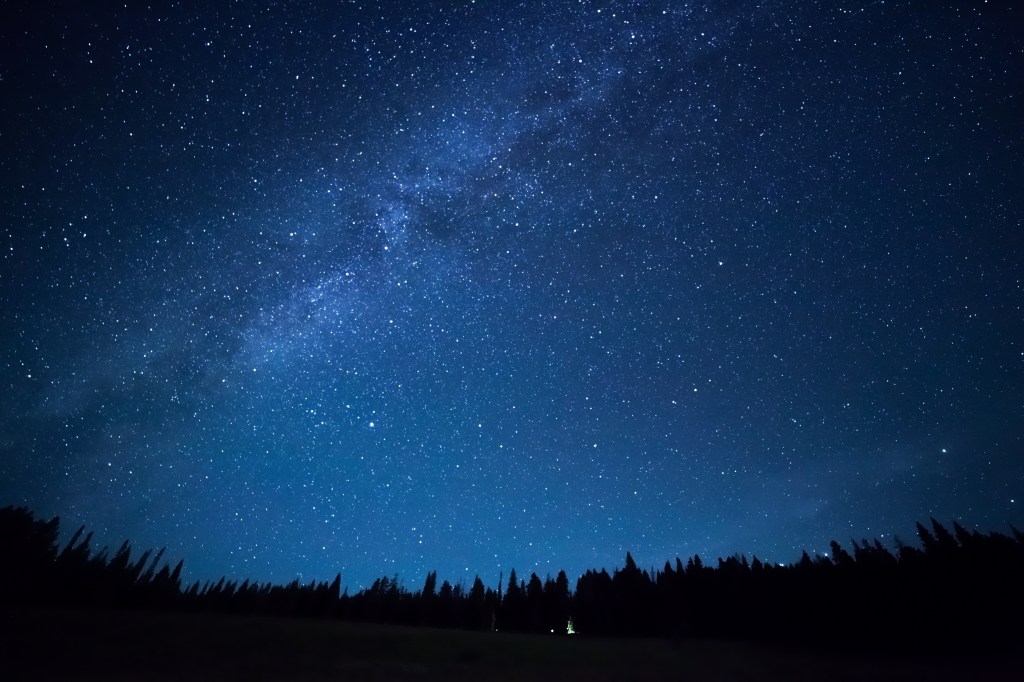
― Ralph Waldo Emerson (1803-1882), Nature and Selected Essays
In his poem, Emerson puts forth the view that they would be regarded with great wonder and remembered and discussed for years to come. They would be recognized as a sign of God.
Not every one agrees with this view, some think the human response would be fear.
Of coure, to a lot of people, it would not make a lot of difference. The majority of people live in or near metropolitan areas, where you are lucky to see the moon, some planets and the brightest stars. Sadly, even in the countryside, where the Milky Way can still be seen, relatively few pay much attention to the night sky splendor. It is almost as though the stars really do appear only once in a thousand years.
On the other hand, without the stars and planets human history would have been significantly different; navigation would have relied on the Sun, discoveries of the laws of gravity and motion would have been delayed and maybe no space travel and satellites.
If the stars only appeared once a millennium they would be mythical. Imagine if the stars had not appeared since 1023 AD and only for one night. How would people react? 1,000 years ago, Europe was in the Dark Ages, Canute the Great was king of England, it was the scientific zenith of the Islamic world and the Chinese had just invented gunpowder.
Various Christian clerics predicted the end of the world on 1 January 1000 and following the failure of this prediction, some theorists proposed that the end would occur 1000 years after Jesus’ death (1033), instead of his birth. Can you imagine how people would react – awe of God or fear of God?
One view of the stars only appearing every 1,000 years has been turned into what has been described as the most famous science fiction short story ever, Nightfall, a ground-breaking feat of literature that tried to answer the question of what the stars mean to us.

Isaac Asimov, who was a young Chemistry graduate and budding science fiction author, was approached by Astounding Science Fiction editor John Campbell with an assignment.
Campbell thought “men would go mad”. And so, Campbell set Asimov off on his longest writing assignment yet. Asimov would turn this idea into a masterpiece.
Emerson’s poem appears in the front of Asimov’s “Nightfall” which describes a planet with 6 suns and nightfall only once every 2,000 years. The advent of nightfall and visible stars causes mass hysteria, mass madness and the total collapse of that planet’s civilization.
Read the story and ask yourself the question: What do the stars mean to you? And if the stars hadn’t been seen for a thousand years till today, what would you do? As an avid star-gazer, this is the greatest takeaway I had from this book. Questions that will never be completely answered.
PS: I love coffee. BuyMeACoffee, leave a message with a date and time and we can share it, remotely, at the same time, and think about the Cosmos.
In the meantime, take care of yourself and if you can, someone else, too, because as Adam Smith said, “we naturally desire not only to be loved but to be lovely”.
 Stargazing Guy
Leave a comment