
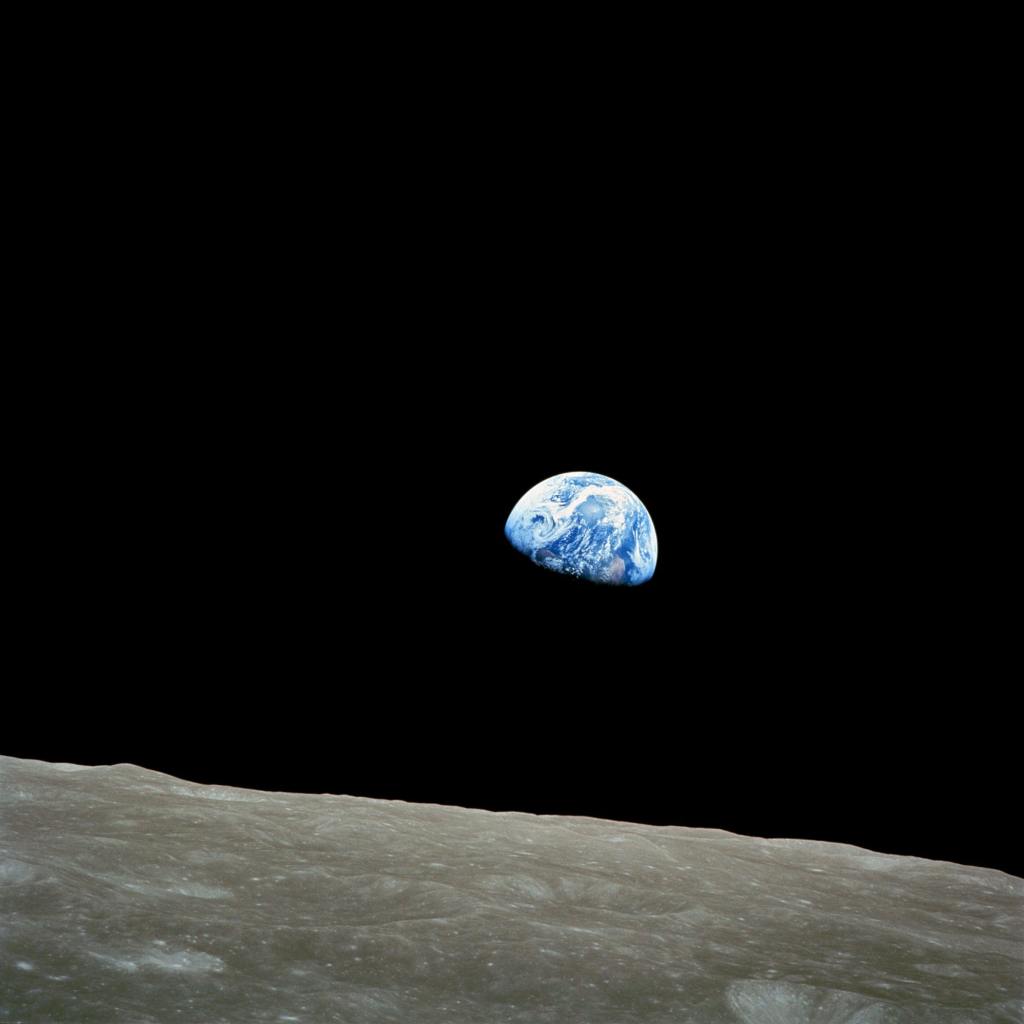
Because we have photos taken from space, duh! I hear you say. True, but how did we know before space flight?
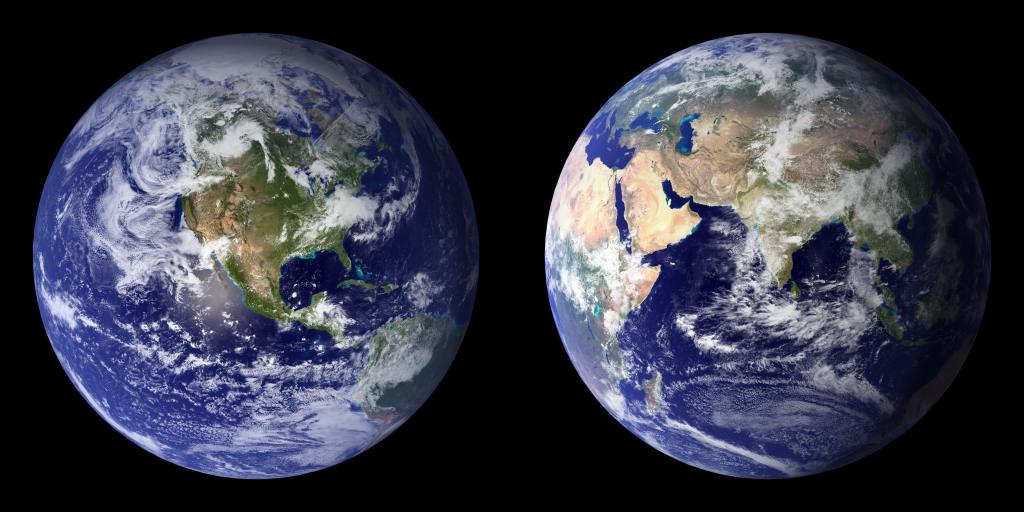
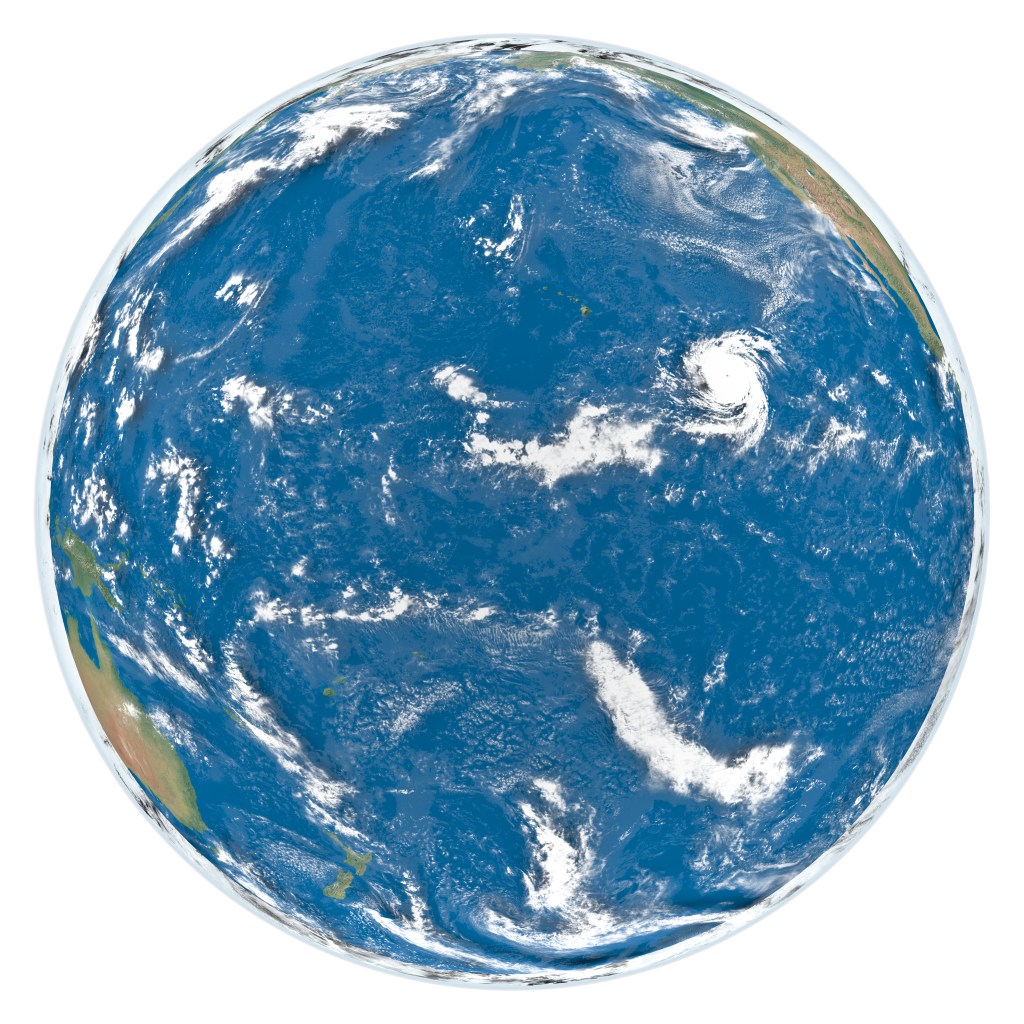
Of course, the Earth isn’t round, it’s more technically accurate to say that it’s an oblate spheroid, though from space it just looks like a big blue ball.
Look out your window and what do you see?
You might be at the bottom of a valley looking up the sides or along the valley floor.
You might be up a hill or on a mountainside looking down to a valley or the plains.
You might be looking out over the sea or a lake or river or other large body of water.
You might live somewhere really flat – like the Kansas wheat fields or the Siberian tundra or the Bonneville Salt Flats.
To be honest, it’s hard to believe the Earth is round using your own eyes – but it’s definitely wrinkly – and that would have been the same for the whole of humanity before the space age.
In most people’s ordinary day-to-day life, the shape of the Earth does not play a major factor. If you design bridges or fire bullets or shells long distances or you fly a plane, etc then the shape and the forces acting on it and you are very important.
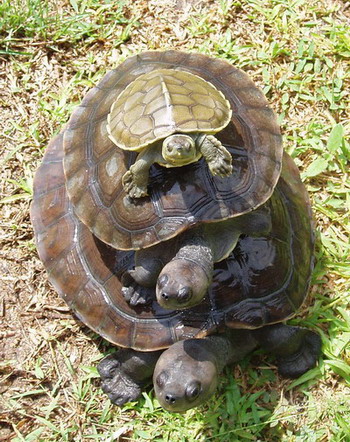
There is a lot of myth and tales about a ‘flat earth’ ranging from whether Columbus would sail over the edge of the world in his search for the Indies to stories about the Earth resting on the back of a turtle, which in its turn rested on the back of another turtle (its turtles all the way down).
Its is well known that the Ancient Greeks knew the world was round. Pliny the Elder, in his The Natural History states:
CHAP. 2. (2.)—OF THE FORM OF THE WORLD
“That it has the form of a perfect globe we learn from the name which has been uniformly given to it, as well as from numerous natural arguments. For not only does a figure of this kind return everywhere into itself and sustain itself, also including itself, requiring no adjustments, not sensible of either end or beginning in any of its parts, and is best fitted for that motion, with which, as will appear hereafter, it is continually turning round; but still more, because we perceive it, by the evidence of the sight, to be, in every part, convex and central, which could not be the case were it of any other figure.”
This doctrine was maintained by Plato, and adopted by Aristotle, and by Cicero. The spherical form of the world, οὐρανὸς, and its circular motion are insisted upon by Ptolemy, in the commencement of his astronomical treatise, Magna Constructio, frequently referred to by its Arabic title Almagestum, cap. 2.
A method to determine the circumference of the Earth was detailed by Eratosthenes, a Greek mathematician, in the 3rd century BC. Famously demonstrated by Carl Sagan in his 1980’s TV documentary Cosmos.
Sagan stated that “Eratosthenes’ only tools were sticks, eyes, feet and brains—plus a zest for experiment. With those tools, he correctly deduced the circumference of the Earth—to high precision—with an error of only a few percent. That’s pretty good figuring for 2,200 years ago.”
Given the fact that the surface of the Earth is wrinkly and bumpy and full of highs and lows, is it possible for an individual to confirm for themselves that the Earth is round? Especially, as the Human Mark 1 eyeball did not evolve for this purpose.
There are several experiments that can be carried out by individuals and teams that demonstrate the round shape. The best answer however is to observe the curvature of the Earth itself as it turns below you.
To do that you need to get up high. There is no exact figure – it depends on your eyesight, your height and distance above the surface, atmospheric conditions, the field of view, etc.
A quick Google turned up a published article on this question (Lynch, 2008). The abstract states:
Reports and photographs claiming that visual observers can detect the curvature of the Earth from high mountains or high-flying commercial aircraft are investigated. Visual daytime observations show that the minimum altitude at which curvature of the horizon can be detected is at or slightly below 35,000 ft, providing that the field of view is wide (60 degrees) and nearly cloud free. The high-elevation horizon is almost as sharp as the sea-level horizon, but its contrast is less than 10% that of the sea-level horizon. Photographs purporting to show the curvature of the Earth are always suspect because virtually all camera lenses project an image that suffers from barrel distortion. To accurately assess curvature from a photograph, the horizon must be placed precisely in the centre of the image, i.e., on the optical axis.
Note that the given minimum of 35,000 feet (10.7 km) is a plausible cruise altitude for a commercial airliner, but you probably shouldn’t expect to see the curvature on a typical commercial flight, because:
- 10.7 km is the bare minimum for seeing curvature, so the apparent curvature will be very slight at this altitude.
- 10.7 km is near the upper end of the usual range of commercial cruise altitudes. Many flights won’t get this high, and very few will go significantly higher.
- A passenger window may not give the necessary 60° field of view, especially if you’re over the wing.
- As the quotation states, you need a nearly cloud-free horizon to perceive the curvature.
The explanation above of the difficulty of seeing the curvature at 35,000 feet (10.7 km) is extracted from a site that offers further details and the relevant formula for calculating it yourself.
Other comments on this site note that it’s hard to see the curvature of the earth from an altitude of 7 miles or 37,000 ft (typical cruising altitude of a jetliner) but easy to see from 250 miles (typical altitude of the International Space Station – ISS).
The line of sight from an aircraft at 37,000 feet = 235 miles. That’s only about 3.4 degrees of the earth’s surface. From the ISS at 250 miles, the line of sight is 1,435 miles, which covers about 19.8 degrees of the earth’s surface – much easier to see the curve from this altitude.
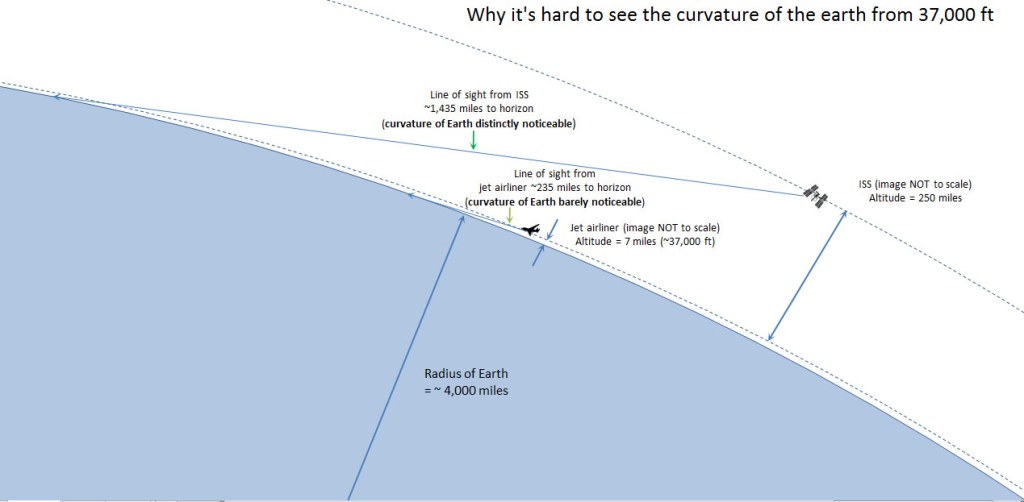
Most people don’t realize how large the earth is compared to the altitude of a passenger aircraft. It’s easy to think we’re really high up, but comparatively, we’re just skimming the Earth’s surface.
So maybe you know the pilot of a spy plane (they fly much higher than commercial jets) or maybe you’ll get to go on the ISS. Maybe you will get lucky the next time you take a commercial airliner. Your only other chance will be space tourism.
Perhaps you’ll be able to afford a sub-orbital flight with Sir Richard Branson or Jeff Bezos or a balloon ride with Halo Space – I’d buy a ticket if I had the spare cash. The opportunity to experience the Overview Effect would be amazingly thought-provoking and mind-blowing!
Given that about 71 per cent of the Earth’s surface is water-covered, and the oceans hold about 96.5 per cent of all Earth’s water.
The real question is why do we call it ‘the Earth’ and not ‘the Ocean’?
Ad Astra!!
Credit for opening image: https://www.pexels.com/photo/blue-and-white-planet-display-87009/


Leave a Reply