
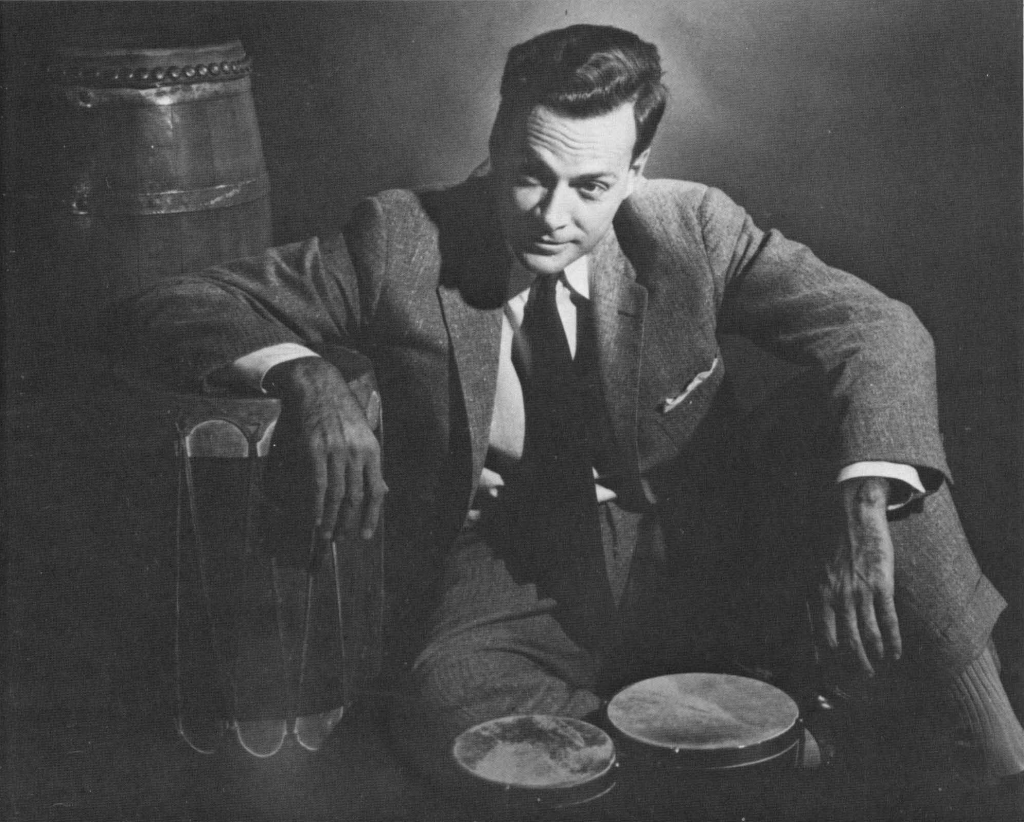
– Richard P. Feynman (11 May 1918 – 15 Feb 1988)
What is there to say about Richard Feynman, American theoretical physicist who was probably the most brilliant, influential, and iconoclastic figure in his field. His lifelong interest was in subatomic physics. In 1965, he shared the Nobel Prize in Physics for his work in quantum electrodynamics.
This quote is taken from The Feynman Lectures on Physics, perhaps the most popular physics book ever written. It has been printed in a dozen languages. More than 1.5 million copies have sold in English, and probably even more in foreign language editions (the number of copies printed in Russian alone, for example, is estimated to be over 1 million). The Feynman Lectures on Physics have endured for over 40 years, and they have influenced thousands of people.

Published back in 1964 it was been revised and extended in 2005 – By Barak Sh – Own work, Public Domain, https://commons.wikimedia.org/w/index.php?curid=4010903
The lectures are a marvellous introduction to the world of physics which, as Feynman states, got started by astronomy by showing the beautiful simplicity of the motion of the stars and planets, the understanding of which was the beginning of physics. But the most remarkable discovery in all of astronomy is that the stars are made of atoms of the same kind as those on the earth.
When lecturing on physics, Feynman said first, we do not yet know all the basic laws: there is an expanding frontier of ignorance (which is still true today). Second, the correct statement of the laws of physics involves some very unfamiliar ideas which require advanced mathematics for their description. Therefore, one needs a considerable amount of preparatory training even to learn what the words mean. No, it is not possible to do it that way. We can only do it piece by piece.
Each piece, or part, of the whole of nature is always merely an approximation to the complete truth, or the complete truth so far as we know it. In fact, everything we know is only some kind of approximation, because we know that we do not know all the laws as yet. Therefore, things must be learned only to be unlearned again or, more likely, to be corrected.
The principle of science, the definition, almost, is the following: The test of all knowledge is experiment. Experiment is the sole judge of scientific “truth.” But what is the source of knowledge? Where do the laws that are to be tested come from? Experiment, itself, helps to produce these laws, in the sense that it gives us hints. But also needed is imagination to create from these hints the great generalizations—to guess at the wonderful, simple, but very strange patterns beneath them all, and then to experiment to check again whether we have made the right guess. This imagining process is so difficult that there is a division of labor in physics: there are theoretical physicists who imagine, deduce, and guess at new laws, but do not experiment; and then there are experimental physicists who experiment, imagine, deduce, and guess.
This is science.
Feynman was well-known for his opposition to rote learning or unthinking memorization and other teaching methods that emphasized form over function.
In 1974, Feynman delivered the Caltech commencement address on the topic of cargo cult science, which has the semblance of science, but is only pseudoscience due to a lack of “a kind of scientific integrity, a principle of scientific thought that corresponds to a kind of utter honesty” on the part of the scientist. He instructed the graduating class that:
“The first principle is that you must not fool yourself—and you are the easiest person to fool. So you have to be very careful about that. After you’ve not fooled yourself, it’s easy not to fool other scientists. You just have to be honest in a conventional way after that.”
Richard P. Feynman was a regular polymath (like they had in the old days), a scientist, teacher, raconteur, and drummer – what a guy?! He assisted in the development of the atomic bomb, expanded the understanding of quantum electrodynamics, translated Mayan hieroglyphics, and cut to the heart of the Challenger disaster.
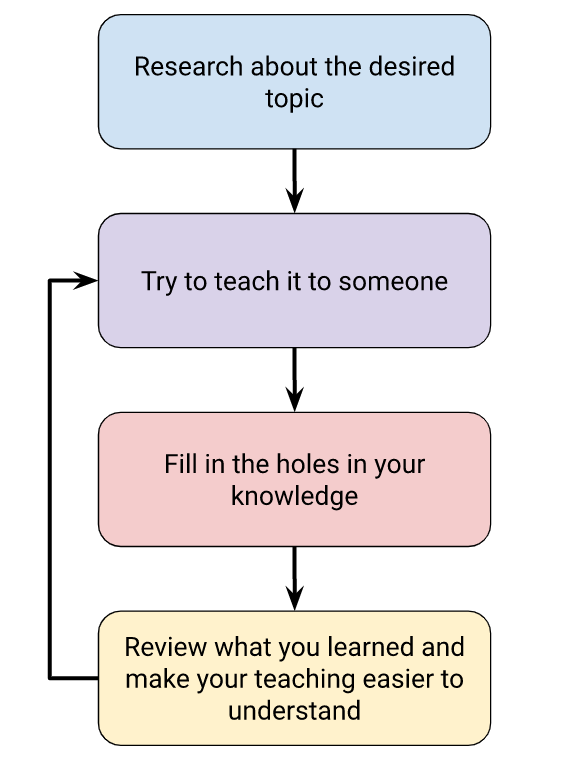
To my mind one of his abiding lessons was his method for deeply learning and internalizing topics. Now known as the Feynman technique, it’s a simple process, containing 4 repeatable steps:
Don’t be surprised if there are more quotes from Feynman in future blogs.
PS: I love coffee. BuyMeACoffee, leave a message with a date and time and we can share it, remotely, at the same time, and think about the Cosmos.
In the meantime, take care of yourself and if you can, someone else, too, because as Adam Smith said, “we naturally desire not only to be loved but to be lovely”.
Contact Stargazing Guy for any copyright-related requests or queries @ stargazer1@stargazingguy.co.uk
No copyright owner known for opening image
 Stargazing Guy
Leave a comment