
— Christopher Paolini, To Sleep in a Sea of Stars
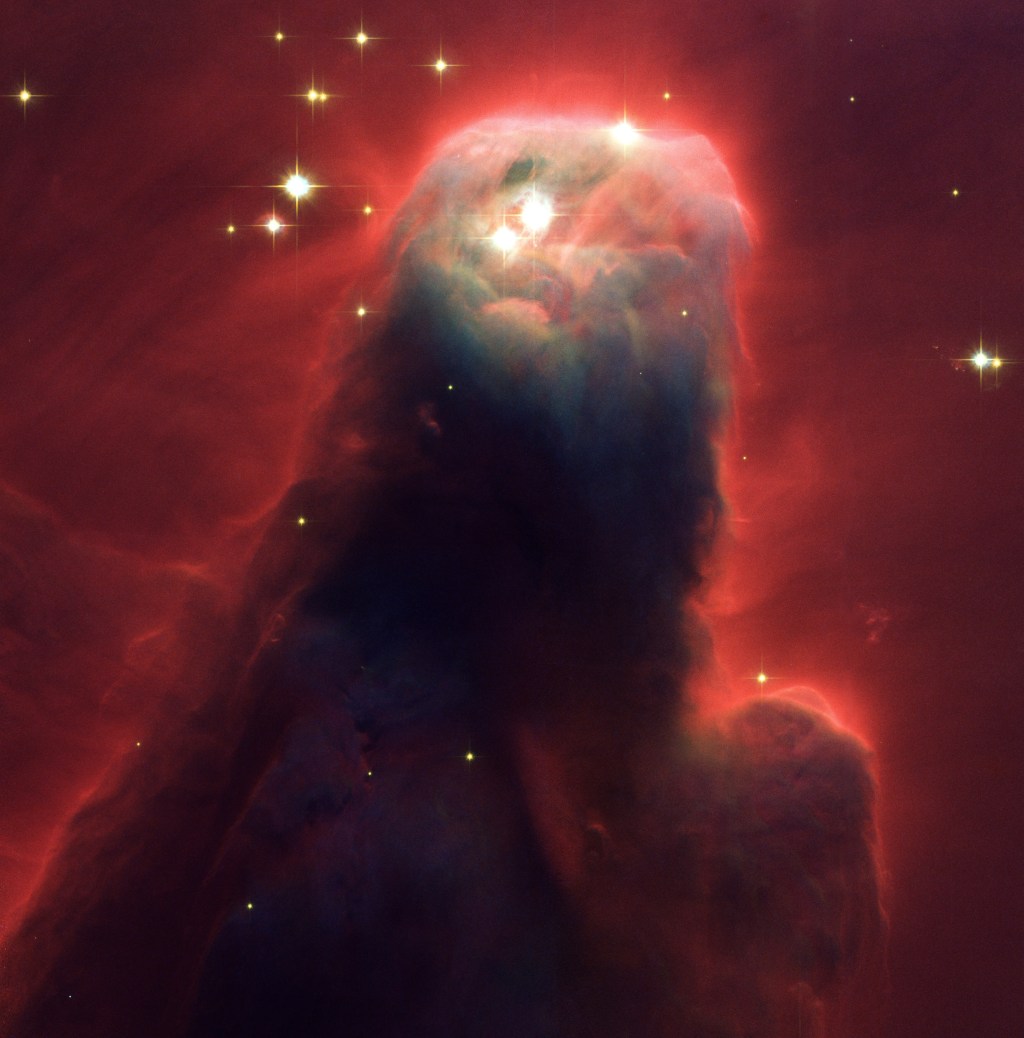
Go to the bottom of this post to read about this incredible image of the Cone Nebula

The full quote is:
“Have you ever considered the fact that everything we are originates from the remnants of stars that once exploded?” Jorrus said, “Vita ex pulvis.” “We are made from the dust of dead stars.”
Two of the characters in the book is discussing their philosophy (they are Entropists) with the main protagonist, Kira. They go on to insist that we are the mind of the universe. We are watching and learning the universe itself in order to expand beyond this realm and escape the heat death of the universe. They conclude by stating that this act of observation and learning is a process we all share and as such gives purpose to our lives, and importance beyond ourselves, importance on a cosmic scale.
Christopher Paolini has created a future-history website with background about the setting for the novel which includes great ideas such as space elevators, aliens, faster than light travel, etc. Aside from being an engrossing space opera with epic space battles, hideous aliens and advanced genetic engineering it takes time to develop the characters and discuss concepts important to all humans (and aliens!).
Does your life have meaning because we are watching and learning the universe? Are we that important beyond our selves? It sounds a little overblown, trying to place intelligence and humanity back at the centre of creation – an appeasement to religions? How would we know?
You tell me – views and opinions gratefully received.
PS: I love coffee. BuyMeACoffee, leave a message with a date and time and we can share it, remotely, at the same time, and think about the Cosmos.
In the meantime, take care of yourself and if you can, someone else, too, because as Adam Smith said, “we naturally desire not only to be loved but to be lovely”.
Credit for opening image of the Cone Nebula (NGC 2264).
Called the Cone Nebula (NGC 2264) — so named because, in ground-based images, it has a conical shape — this giant pillar resides in a turbulent star-forming region 2,500 light-years away in the constellation Monoceros
 Stargazing Guy
Leave a comment