
– Sir Isaac Newton PRS (25 December 1642 – 1726/27)*
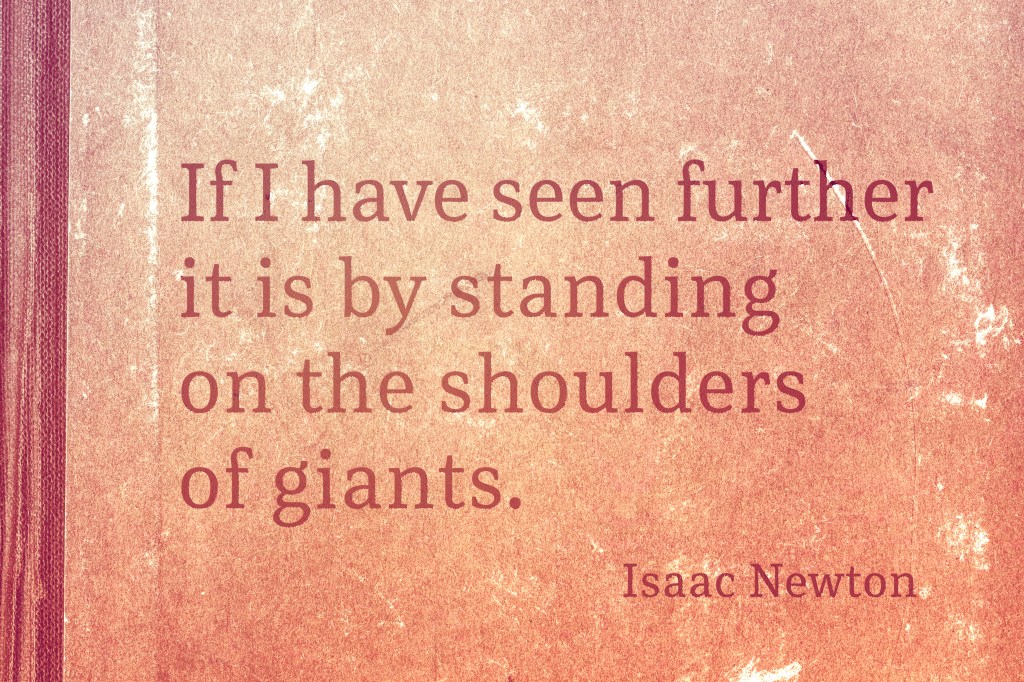
Newton was relatively modest about his achievements, writing in a letter to Robert Hooke in February 1676, “If I have seen further it is by standing on the shoulders of giants.”
In a later memoir, Newton wrote, “I do not know what I may appear to the world, but to myself I seem to have been only like a boy playing on the sea-shore, and diverting myself in now and then finding a smoother pebble or a prettier shell than ordinary, whilst the great ocean of truth lay all undiscovered before me.”
Newton formulated the laws of motion and universal gravitation that formed the dominant scientific viewpoint for centuries until it was superseded by the theory of relativity. Newton used his mathematical description of gravity to derive Kepler’s laws of planetary motion, account for tides, the trajectories of comets, the precession of the equinoxes and other phenomena, eradicating doubt about the Solar System’s heliocentricity. He demonstrated that the motion of objects on Earth and celestial bodies could be accounted for by the same principles. Newton’s inference that the Earth is an oblate spheroid was later confirmed by the geodetic measurements of Maupertuis, La Condamine, and others, convincing most European scientists of the superiority of Newtonian mechanics over earlier systems.
An English physicist and mathematician, he was the culminating figure of the Scientific Revolution of the 17th century and is probably most famous for the legend that in 1665 or 1666 after watching an apple fall and asking why the apple fell straight down, rather than sideways or even upward, he formulated the law of universal gravitation:

The law of Gravitation essentially states that every particle attracts every other particle in the universe with a force that is proportional to the product of their masses and inversely proportional to the square of the distance between their centres.
This clip from the BBC’s Human Universe, hosted by Professor Brian Cox, shows what happens when a bowling ball and a feather are dropped together under the conditions of outer space (proving Newton – and Galileo – correct):
Newton also stated the three universal laws of motion:
- The first law of Motion – An object at rest remains at rest, and an object in motion remains in motion at constant speed and in a straight line unless acted on by an unbalanced force
- Second Law of Motion – The acceleration of an object depends on the mass of the object and the amount of force applied
- Third Law of Motion – Whenever one object exerts a force on another object, the second object exerts an equal and opposite on the first
Together, these laws describe the relationship between any object, the forces acting upon it and the resulting motion, laying the foundation for classical mechanics. They contributed to many advances during the Industrial Revolution which soon followed and were not improved upon for more than 200 years. Many of these advances continue to be the underpinnings of non-relativistic technologies in the modern world. He used the Latin word gravitas (weight) for the effect that would become known as gravity.
Credit: mainly drawn from Wikipedia, Encyclopedia Britannica and National Geographic – which will provide much more information on the man and his works – especially for some of the science of the time such as alchemy, the occult and his odd behaviour.
PS: I love coffee. BuyMeACoffee, leave a message with a date and time and we can share it, remotely, at the same time, and think about the Cosmos.
In the meantime, take care of yourself and if you can, someone else, too, because as Adam Smith said, “we naturally desire not only to be loved but to be lovely”.
* During Newton’s lifetime, two calendars were in use in Europe: the Julian (“Old Style”) calendar in Protestant and Orthodox regions, including Britain; and the Gregorian (“New Style”) calendar in Roman Catholic Europe. Newton died in his sleep in London on (OS 20 March 1726; NS 31 March 1727).
 Stargazing Guy
Leave a comment