
— Sir John Frederick William Herschel (7 March 1792 – 11 May 1871)
According to Wikipedia, Herschel, was an English polymath active as a mathematician, astronomer, chemist, inventor, experimental photographer who originated the use of the Julian day system in astronomy. He named seven moons of Saturn and four moons of Uranus – the seventh planet, discovered by his father Sir William Herschel.
Although Herschel did not possess the instruments needed to create positional star catalogues, his rhetoric of the stars as ‘land-marks of the universe’ aiding in a host of practical applications on the Earth (to serve astronomers, geographers, navigators and surveyors) was repeated in the works of other astronomers during this period. As quoted in Essays from the Edinburgh and Quarterly Reviews: with addresses and other pieces, 1857, “The stars are the land-marks of the universe; and amidst the endless and complicated fluctuations of our system, seem placed by its Creator as guides and records, not merely to elevate our minds by the contemplation of what is vast, but to teach us to direct our actions by reference to what is immutable in his works.”
Its through the painstaking work of Herschel and others that helped promote the merits of positional catalogues (for their practical utility) but also continues to inspire us in the contemplation and consideration of the beauty of the universe, whatever your views on how it came into being.
All cultures across human history have named stars, planets and constellations and stars – all for the same reasons of mythology, religion and practicality.
One fascinating sky culture is Polynesian star lore and specifically Hawaiian Star lines. These are related to the revival of voyaging and non-instrument navigation (wayfinding) across the Pacific Ocean.
The wayfinder memorizes the position of stars on the celestial sphere to use them as directional clues when they rise and set. On cloudy nights, when only parts of the sky are visible, he may recognize isolated stars or star groups and imagine the rest of the celestial sphere around them.
To help remember the pattern of stars in the sky, the sky has been organized into four star lines, each line taking up about one fourth of the night sky:
- Ke Ka o Makali‘i (“The Canoe-Bailer of Makali‘i”)
- Iwikuamo‘o (“Backbone”)
- Manaiakalani (“The Chief’s Fishline”)
- Ka Lupe o Kawelo (“The Kite of Kawelo”)

There is far too much detail to cover here – but its an amazing insight into what the stars can do for humanity – and there are many other star cultures. More information on the Polynesian Voyaging Society is available here: https://www.hokulea.com/
PS: I love coffee. BuyMeACoffee, leave a message with a date and time and we can share it, remotely, at the same time, and think about the Cosmos.
In the meantime, take care of yourself and if you can, someone else, too, because as Adam Smith said, “we naturally desire not only to be loved but to be lovely”.
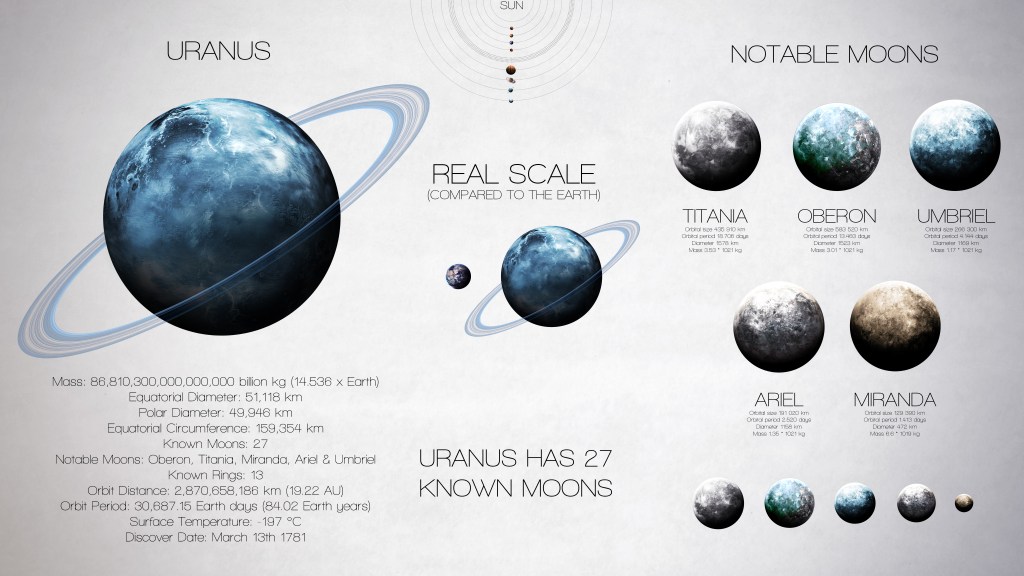
Credit for opening image: https://depositphotos.com/92638100/stock-photo-uranus-high-resolution-infographics-about.html
The first two moons (Titania and Oberon) were discovered by William Herschel on March 13, 1787. Two more moons (Ariel and Umbriel) were discovered by William Lassell in 1851. In 1852, Herschel’s son John Herschel gave the four then-known moons their names.
 Stargazing Guy
Leave a comment