

Galileo Galilei (15 February 1564 – 8 January 1642) (Sarah Williams, Poet – December 1837 – 25 April 1868)
This quote is often attributed to Galileo, incorrectly. The full poem, with that line, is quoted and fully credited below.
Galileo was an Italian astronomer, physicist and engineer who studied speed and velocity, gravity and free fall, the principle of relativity, inertia, projectile motion and also worked in applied science and technology, describing the properties of pendulums and “hydrostatic balances”. He invented the thermoscope and various military compasses and used the telescope for scientific observations of celestial objects. His contributions to observational astronomy include telescopic confirmation of the phases of Venus, observation of the four largest satellites of Jupiter, observation of Saturn’s rings, and analysis of lunar craters and sunspots.
Between 1589 and 1592, it is said he dropped two spheres of the same volume but different masses from the Leaning Tower of Pisa to demonstrate that their time of descent was independent of their mass. Nicely demonstrated by Dave Scott, seventh person to walk on the Moon, during Apollo 15:
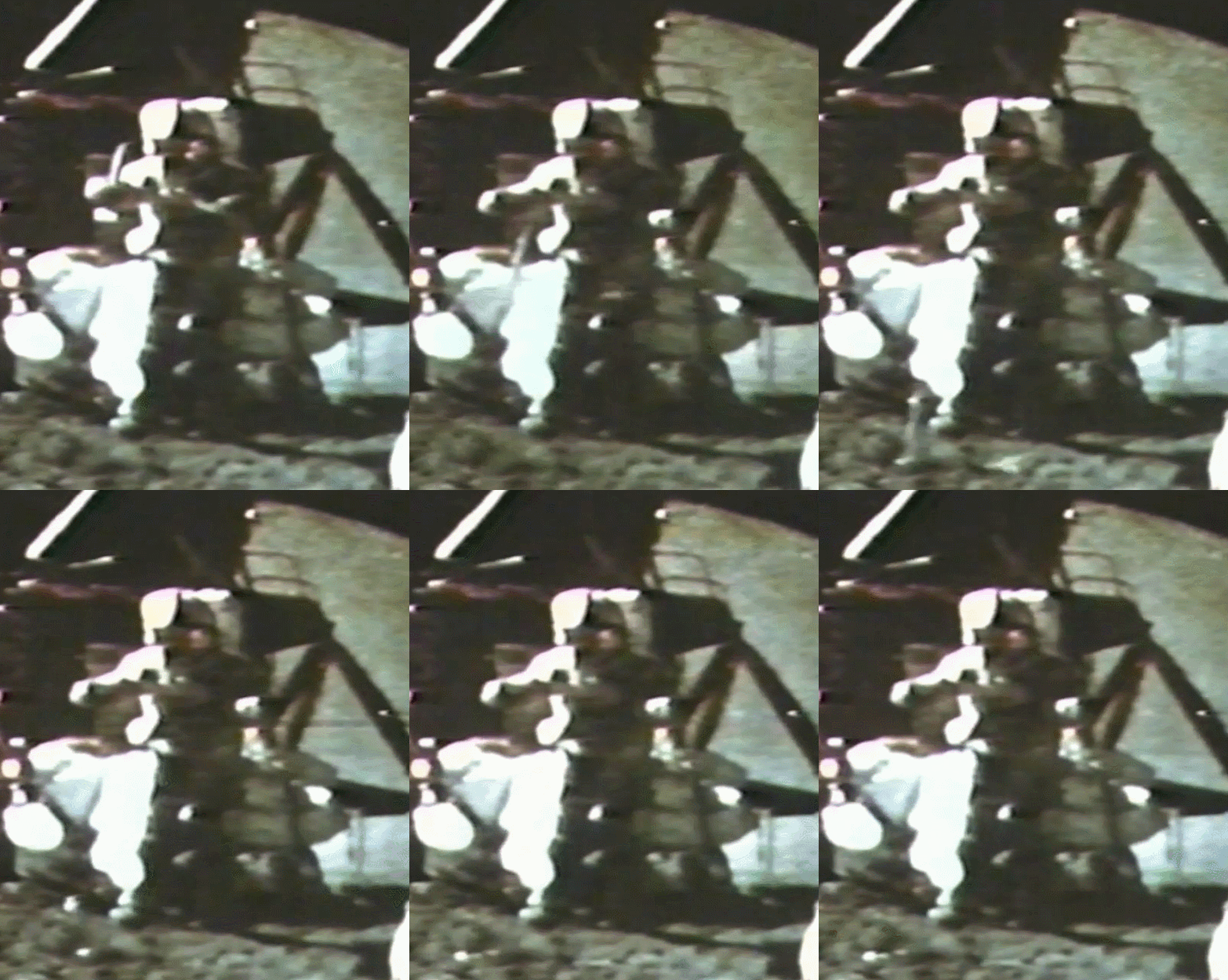
NASA, Public domain, via Wikimedia Commons – The famous hammer and feather experiment on the Moon, by Dave Scott: In the absence of an atmosphere, all bodies subjected to a gravity field accelerate identically, i.e. they fall at the same speed, whether they are heavy or light.
According to the story, Galileo discovered through this experiment that the objects fell with the same acceleration, proving his prediction true, while at the same time disproving Aristotle’s theory of gravity (which states that objects fall at a speed proportional to their mass). Most historians consider it to have been a thought experiment rather than a physical test.
His support for Copernican heliocentrism (ie the Earth rotating daily and revolving around the Sun) was met with opposition from within the Catholic Church and from some astronomers.
He’s been called the “father of observational astronomy”, the “father of modern physics”, the “father of the scientific method”, and the “father of modern science”.
A stargazer extraordinaire – and an important figure in the development of the modern world.
The Old Astronomer to His Pupil
“Reach me down my Tycho Brahe, I would know him when we meet,
When I share my later science, sitting humbly at his feet;
He may know the law of all things, yet be ignorant of how
We are working to completion, working on from then to now.
Pray remember that I leave you all my theory complete,
Lacking only certain data for your adding, as is meet,
And remember men will scorn it, ’tis original and true,
And the obloquy of newness may fall bitterly on you.
But, my pupil, as my pupil you have learned the worth of scorn,
You have laughed with me at pity, we have joyed to be forlorn,
What for us are all distractions of men’s fellowship and smiles;
What for us the Goddess Pleasure with her meretricious smiles!
You may tell that German College that their honor comes too late,
But they must not waste repentance on the grizzly savant’s fate.
Though my soul may set in darkness, it will rise in perfect light;
I have loved the stars too fondly to be fearful of the night.”
Sarah Williams
(from Best Loved Poems of the American People, Hazel Felleman, ed.
Garden City Publishing Co., Garden City NY: 1936, pp. 613-614)
The last line was used as an epitaph for an Astronomer-couple buried at Alleghany Observatory.
It seems reasonable to link the poem with Galileo – and imagine its actually him talking to his pupil.
PS: I love coffee. BuyMeACoffee, leave a message with a date and time and we can share it, remotely, at the same time, and think about the Cosmos.
In the meantime, take care of yourself and if you can, someone else, too, because as Adam Smith said, “we naturally desire not only to be loved but to be lovely”.
![“If I have seen further [than others], it is by standing on the shoulders of giants.” – Stargazing Guy Avatar](https://stargazingguy.co.uk/wp-content/uploads/2023/01/cropped-icons8-multiple-stars-24.png?w=40)

 Stargazing Guy
Leave a comment