
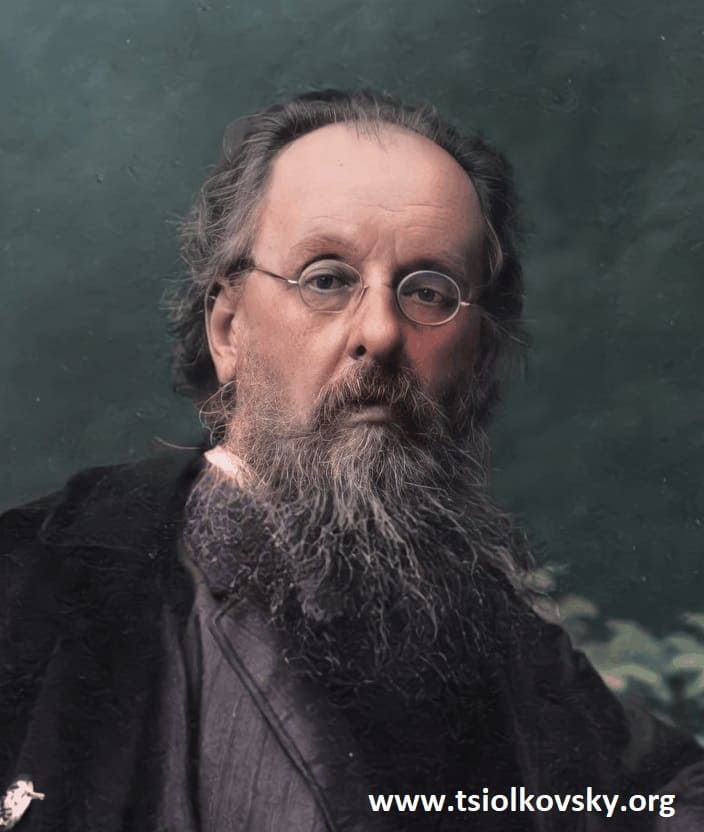
– Konstantin Tsiolkovsky (17 September 1857 – 19 September 1935)

Tsiolkovsky is remembered for believing in the dominance of humanity throughout space. He had grand ideas about space industrialization and the exploitation of its resources.
Long before the beginning of the space era, this Great Russian scientist derived a formula for space rockets’ overcoming the earth’s gravity.
Tsiolkovsky’s scientific heritage consists of 400 works including drawings of jet rockets, different calculations and forecasts, philosophical works and fantastic novels about inter-planetary voyages
Tsiolkovsky has been honoured since his death in 1935. A far-side moon crater is named in his honour. In 1989 he was invested in the International Aerospace Hall of Fame.
The Konstantin E. Tsiolkovsky State Museum of the History of Cosmonautics in Kaluga, Russia, keeps the importance of his theoretical work before the public. In Russia, Konstantin Tsiolkovsky is called “the father of theoretical and applied cosmonautics.” Although the Romanian Oberth and the American Goddard conducted similar research and arrived at comparable conclusions, there is no evidence that each knew details of the other’s work. Therefore, all three of these scientists share the title of Father of Rocketry.
One of the greats, not only able to work practically, he was able to dream of the future when we make our home amongst the stars.
“Men are weak now, and yet they transform the Earth’s surface. In millions of years their might will increase to the extent that they will change the surface of the Earth, its oceans, the atmosphere and themselves. They will control the climate and the solar system just as they control the Earth. They will travel beyond the limits of our planetary system; they will reach other Suns and use their fresh energy instead of the energy of their dying luminary.”
PS: I love coffee. BuyMeACoffee, leave a message with a date and time and we can share it, remotely, at the same time, and think about the Cosmos.
In the meantime, take care of yourself and if you can, someone else, too, because as Adam Smith said, “we naturally desire not only to be loved but to be lovely”.
 Stargazing Guy
Leave a comment